Recognizing matcha quality is not always easy. In web shops you see words such as ceremonial, premium, classic, latte and culinary next to large price differences. Some matcha costs a few euros per package, the other much more. Then the logical question is: do you pay for real quality, for a nice label or for a matcha that does not actually suit what you want to do with it?
The most important answer is practical: you do not only choose good matcha based on price or grade, but on preparation. A soft matcha for hot water needs different properties than matcha for latte, ice cream, cake or desserts. In this guide you can read why prices differ, what matcha grades do and do not say and how you can learn to better judge at home which matcha suits you.
Why matcha can vary so much in price
Price differences in matcha arise from multiple choices in the chain. Consider how tea plants are shaded, which leaves are selected, when they are harvested, how carefully stems and veins are removed, and how slowly the leaf is ground. Packaging, freshness, storage and scale of production also play a role.
A fine matcha for pure preparation usually requires softer leaves, a fine grind, a fresh color and a taste that does not quickly become harshly bitter. That takes more attention and often more time. A matcha for recipes does not have to have the same refinement, because sugar, fat, milk, cream or flour carry the flavor differently. That doesn't mean that culinary matcha is worthless. It means he has another job.
What matcha grades do and don't say
Matcha grades can be useful, but they are not a legally fixed system that means the same everywhere. One brand may use ceremonial for a soft drinking matcha, while another brand may use premium or classic for a similar application. Therefore, it is smarter to read grade terms as direction, not absolute proof.
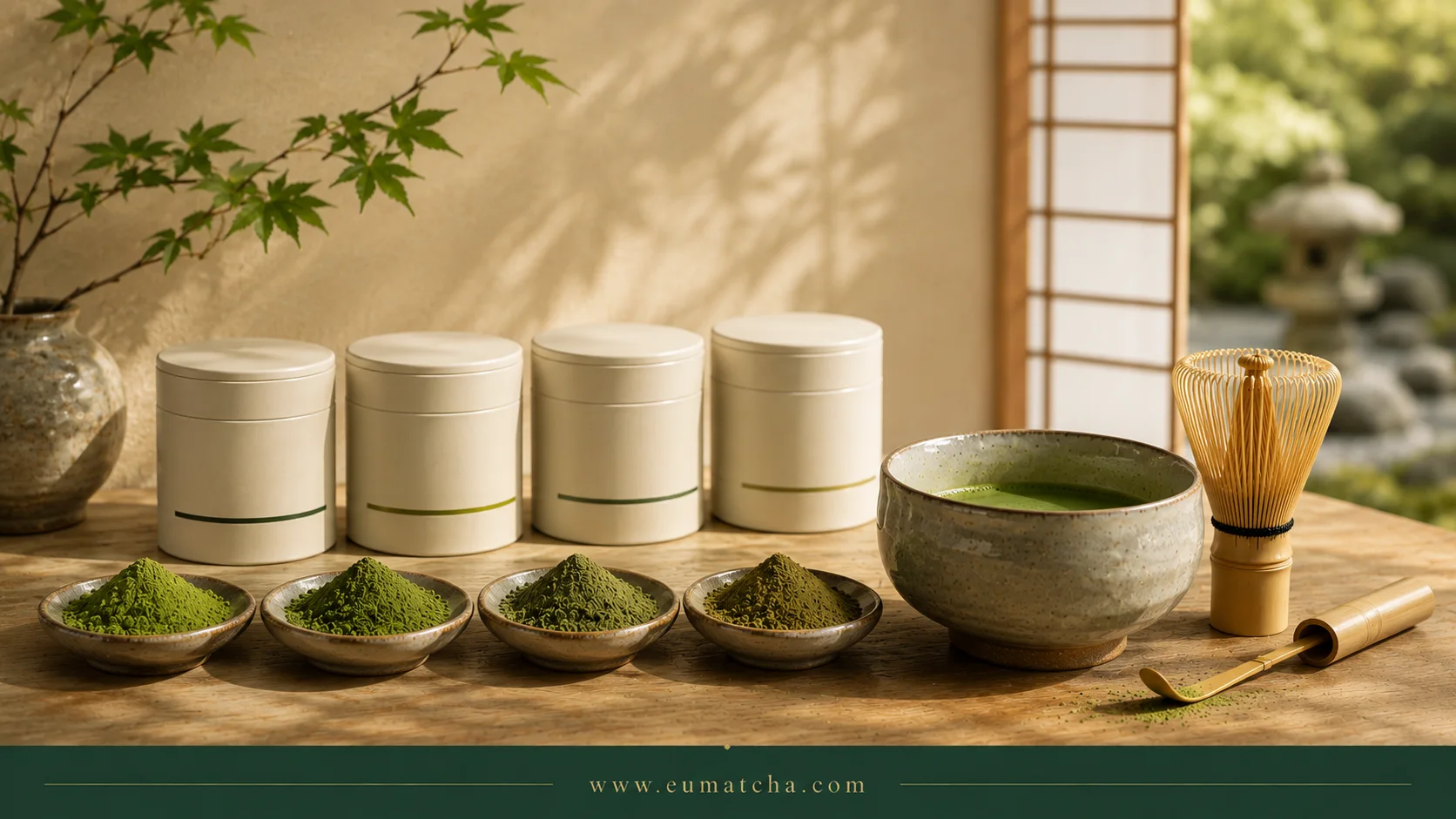
Ceremonial matcha is usually intended for pure preparation with hot water. Premium matcha often falls between pure preparation and modern drinks. Classic or daily matcha may be suitable for regular use. Matcha for latte must remain recognizable in milk. Culinary matcha is intended for baking, desserts, smoothies and other recipes. That classification helps, as long as you also look at taste, color, smell and use.
First choose by preparation: water, latte or recipes
The best matcha for you starts with how you want to use it. If you drink matcha neat with hot water, you want softness, umami, a fine texture and low bitterness. Then look at it sooner ceremonial matcha or a premium matcha that is suitable for pure preparation.
If you mainly make matcha latte, the matcha does not necessarily have to be the most refined drinking matcha. Milk makes the taste rounder and mutes nuance. You need a matcha that dissolves well, retains enough green tea flavor and does not become sharp. See earlier for that matcha for latte. For cake, cookie, ice cream, tiramisu or smoothies culinary matcha often more logical, because color, dosage and result in the recipe are more important than subtlety in hot water.
Assess color, smell and texture
A fresh green color is a positive sign, especially when the powder also smells fresh. Please note: color alone does not tell the whole story. Good matcha smells clean, green and vegetal. Depending on the style, it can appear softly creamy, freshly grassy or slightly nutty. If matcha smells stale, dusty or flat, it is probably less fresh or less well stored.
Texture also says a lot. Finely ground matcha feels soft between your fingers and mixes easier with hot water. Coarser powder can make drinking grainy or lumpy more quickly. Therefore, always strain matcha before preparing it. This is not a luxurious operation, but a simple way to make the preparation smoother and more pleasant.
Why harvest, selection and grinding have an influence
The quality of matcha starts with the leaf. Younger, carefully selected leaves can give a softer and more refined result. The harvest period and the method of processing also influence color, smell and bitterness. Then comes the grind. Slow, careful grinding can help to achieve a fine structure and pleasant mouthfeel.
This does not have to be a technical study for you as a consumer. Use it as an explanation for price differences. When a matcha is more expensive, you can expect that more attention has been paid to leaf selection, processing, grinding or freshness. But ultimately you have to taste it in the preparation for which you buy it.
Provenance helps, but is no guarantee
Japanese regions can provide interesting context. Names like Shizuoka, Kagoshima, Miyazaki, Uji or Nishio say something about tea culture, climate and production background. However, origin alone is not a complete guarantee of quality. Two matchas from the same region can taste very different when cultivar, harvest, leaf selection, processing and storage differ.
Therefore, use origin as an extra layer, not as the sole reason for purchasing. A clear regional statement can provide confidence, but the practical question remains: does this matcha go with hot water, milk or recipes? On our about page origin We therefore explain how to use regional information without blindly relying on it.
When more expensive matcha is not the best choice
More expensive is not always better for your use. A very refined matcha can be beautiful with hot water, but in cake batter or a sweet iced latte you lose a lot of nuance. Then you pay for properties that you hardly taste. Conversely, a strong matcha for recipes can be too bitter or too strong when you drink it neat.
That is exactly why grades make sense per application. For a bowl of matcha with hot water, you look for softness. For latte you look for balance in milk. For recipes, look for color, dosage and recognizable matcha flavor in addition to other ingredients. The best choice is therefore not the most expensive matcha, but the matcha that does its job well in your cup, glass or recipe.
This way you choose wisely as a beginner
Don't start with five types at once. First choose one clear preparation. If you want to drink neat, start with a soft matcha that is intended for that purpose. If you want to make a latte, choose a latte-matcha and test it with milk and plant-based milk. If you want to bake, choose a culinary matcha and assess the end result after mixing, baking or cooling.
Prepare the matcha in the same way a few times. Use hot water that is not boiling, sift the powder and first beat a smooth base. Then you can compare more fairly. If the matcha quickly tastes sharp with hot water, it may go better with milk or recipes. If it disappears completely in milk, you probably need a stronger matcha for latte.
Storage is part of quality
Even good matcha quickly loses character when stored incorrectly. Light, air, heat and moisture flatten color and odor more quickly. Therefore, close the packaging immediately after use, use a dry spoon and store matcha in a cool, dry and dark place. Better to buy a package that suits your rhythm than a large stock that will remain open for months.
This is especially important with premium and ceremonial matcha. There you pay for smell, color, fine texture and mild taste. You can find more practical explanations on our about page store matcha.
Conclusion: recognize matcha quality without confusion
Recognizing matcha quality starts with taking a calmer look. Price and grades provide direction, but they do not tell everything. Pay attention to color, smell, texture, freshness and especially the use for which you buy matcha. If you want to drink pure with hot water, choose softness and low bitterness. If you make a latte, choose a matcha that remains recognizable in milk. If you use matcha in recipes, choose a practical culinary matcha.
If you want to compare further, use our matcha guide or view the EU Matcha shop. This means you don't choose matcha because a label sounds expensive, but because it suits your taste, preparation and daily use.