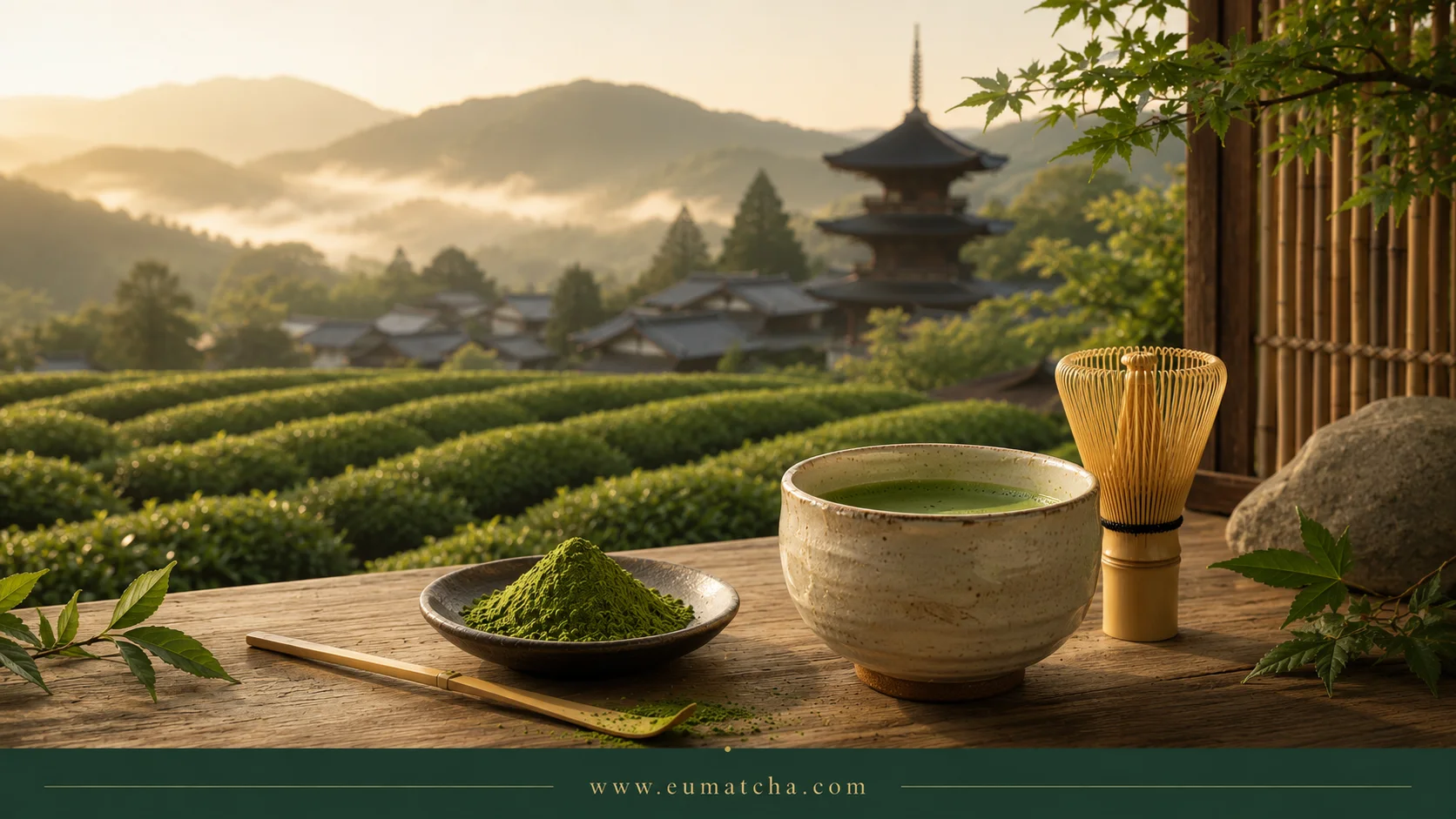
For many people, matcha immediately feels Japanese. You may think of a chasen, a tea bowl, quiet movements and the deep green color of finely ground tea. Yet the origin of matcha does not begin in a modern latte bar and not only in Japan. Its roots reach back to old Chinese tea culture, where tea was already pressed, ground and prepared in different ways.
What makes matcha interesting is exactly that double history. The technique of powdered tea travelled from China to Japan, but Japan gave matcha its own form, taste and cultural meaning. That is why Japanese matcha today is more than green tea powder. It brings together technique, agriculture, preparation and tea culture. When you understand that origin, you also choose more consciously: for pure preparation with hot water, for matcha latte or for recipes.
Where does matcha originally come from?
The oldest roots of matcha lie in China. During the Tang and Song periods, tea was used in ways that were different from the loose tea many people know today. Tea leaves could be steamed, pressed, dried and later ground. In the Song period, powdered tea gained a more refined role in temples and at court. The powder was prepared with hot water and whisked, a method that clearly resembles the way matcha is prepared now.
This does not mean that modern Japanese matcha is simply the same as old Chinese powdered tea. The basic idea, tea as a fine powder in water, travelled across. The Japanese development that followed changed the product deeply. The way the leaf is grown, processed, milled and served became a tradition of its own in Japan.
How powdered tea reached Japan
Tea came from China to Japan in different periods. Monks and scholars played an important role because travel between China and Japan was often connected with Buddhist study. A well-known name in this history is Eisai, a Japanese monk who studied in China and brought powdered tea and tea seeds to Japan.
For Eisai, tea was not only about taste. In his time it was also connected with study, temple life and discipline. For this article, the most important point is that powdered tea found a new setting in Japan. It became not just a drink, but also part of Zen, attention and later a refined way of receiving guests.
Why Japan made matcha its own
In Japan, powdered tea developed further within temples, court culture, the warrior class and later among tea masters. Tea gatherings could first be lavish and competitive, but later gained a more restrained character. The Japanese tea ceremony, often called chado or chanoyu, turned the act of preparing tea into a form of attention, hospitality and aesthetics.
The name Sen no Rikyu belongs to that refinement. He is often linked with wabi-cha: a modest and attentive way of experiencing tea. For consumers today, this does not mean that you need to perform a full tea ceremony at home. It mainly shows why matcha is treated so carefully in Japan. The bowl, the water, the whisking and the moment all matter.
From tencha to modern matcha
Modern matcha is made from tencha: tea leaf intended to be ground into matcha. Tencha differs from ordinary green tea because it is not drunk as loose leaves. The leaf is processed and then milled into a fine powder. With matcha you therefore drink the whole leaf, not only an infusion.
This difference matters. Not every green powder is real matcha. Ordinary green tea powder can add color to recipes, but often lacks the fine texture, aroma and balance you want when preparing matcha with hot water. Japanese matcha is about the combination of leaf quality, processing, milling and freshness. That makes origin practical: it helps you understand why preparation and product choice have so much influence on taste.
Why origin matters for taste
The origin of matcha is not just a decorative story. It explains why matcha tastes different from ordinary green tea. Because you whisk the powder into water or milk, you taste more of the leaf. A good matcha can be soft, rich in umami, fresh green, creamy or stronger and more bitter. That depends on leaf selection, harvest, processing, milling, storage and how you prepare it.
That is why it is not enough to look only at words such as ceremonial, premium or culinary. If you want to drink matcha pure with hot water, you usually look for softness, umami and low bitterness. If you mainly make latte, the matcha should remain recognizable in milk. If you use matcha in cake, ice cream or desserts, the choice is more about color, dosage and how the flavor holds up next to sugar, fat and flour.
Matcha today: tradition and everyday use
Today matcha lives in two worlds at once. On one side there is the Japanese tradition: matcha in a bowl, whisked with a chasen and drunk with attention. On the other side, matcha has become part of latte, iced matcha, chocolate, tiramisu, cookies and smoothies. Modern use does not have to push the origin away, as long as you understand which matcha is meant for which use.
A refined matcha for hot water is not always the most logical choice for cake batter. A culinary matcha is not inferior because it is used for recipes; it simply has a different job. The origin of matcha therefore helps not only with culture, but also with practical choices in the kitchen.
How to start at home with respect for the origin
You do not need to learn a full tea ceremony to prepare matcha well. Start simply. Sift the powder, use hot water that is not boiling and whisk the matcha with a chasen or milk frother. A chasen is a bamboo whisk that helps mix matcha evenly and lightly. First taste matcha pure with hot water so you can better recognize color, aroma, bitterness and umami.
Then compare. Make the same matcha as a latte and notice how much milk softens the taste. Use another matcha in a dessert and pay attention to color and dosage. In this way your knowledge grows naturally through experience. Our page about preparing matcha helps with the practical basics, while the page about Japanese matcha explains more deeply what makes real matcha different.
Conclusion: origin helps you choose better
The origin of matcha begins with Chinese powdered tea, but the matcha we know today was further refined in Japan. Through Zen, tea ceremony, tencha, careful processing and strong attention to preparation, matcha became a recognizable Japanese tea product. That story is beautiful, but also useful.
When you buy matcha, you are not only choosing a green color. You choose a way of drinking or using it. If you want a soft bowl with hot water, look at ceremonial matcha. If you mainly want to compare by taste, use and origin, read our matcha guide or visit the EU Matcha shop. This turns history into more than background: it becomes a way to choose better matcha at home.